Buying advice
Which feather flag base do I need for grass or paving?
Compare ground spikes, cross bases and weighted flag bases. Plan your event surface, pole compatibility and placement before choosing in Studio.
Start with the surface, then choose the base
A flag design can work across several events, but the same base will not automatically suit every pitch. Before ordering, ask whether the flag will stand on grass, paving, tarmac or an indoor floor. Check whether the organiser permits anything to be driven into the ground and how much space you have outside your gazebo. The useful buying question is not simply which base costs least: it is which compatible support suits the location and the selected flag.
Grass: check permission before selecting a spike
A ground spike is an option for suitable penetrable ground. Grass alone does not tell you whether installation is permitted or practical. Ask the organiser about ground conditions, buried services and restrictions before using a spike. Do not assume that a lawn over a hard surface or a temporary covering can accept one. If ground penetration is prohibited, discuss a compatible weighted arrangement instead. A Studio preview shows appearance, not whether a particular patch of ground is suitable.
Paving: compare bases that sit on the surface
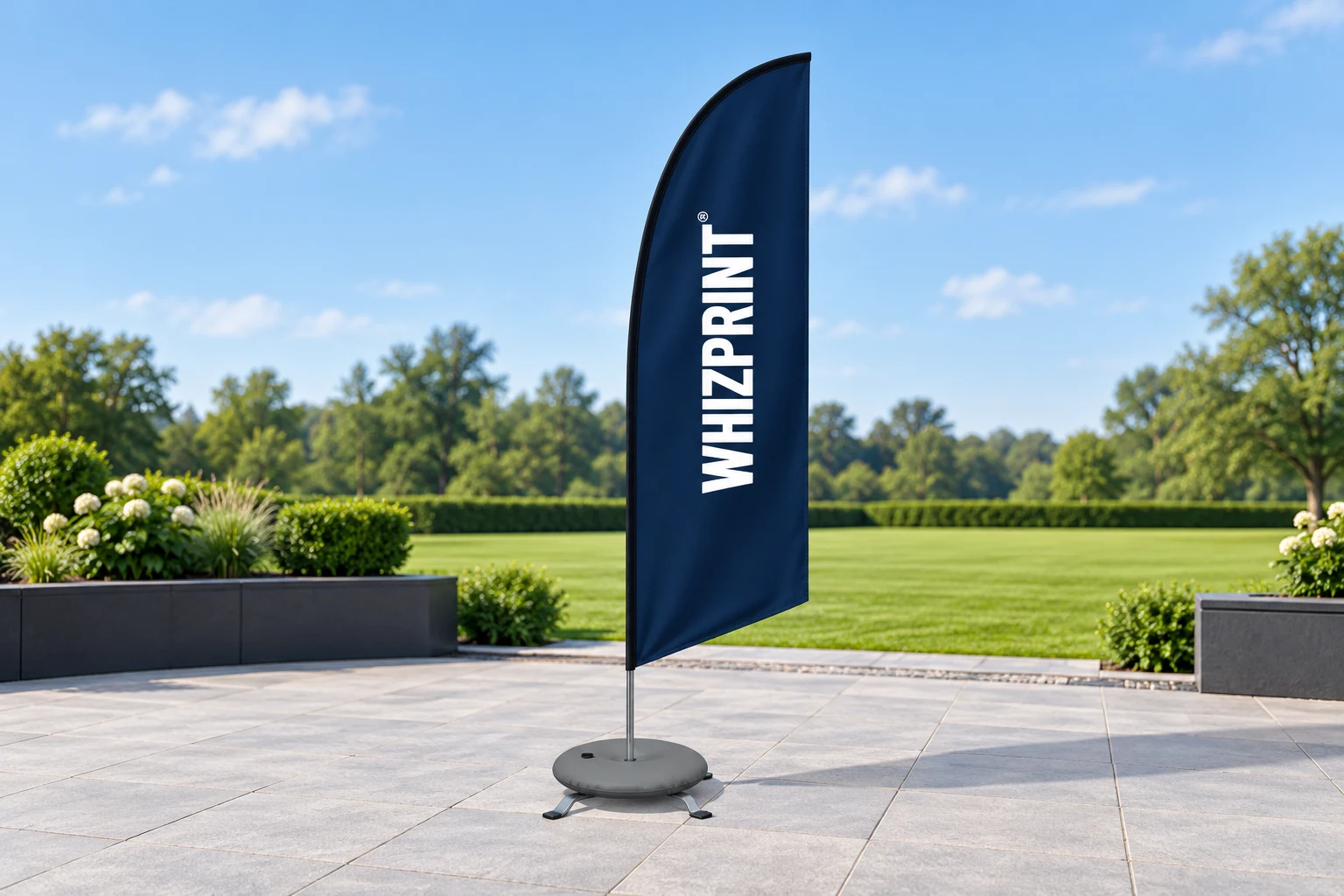
A ground spike is not an installation choice for concrete, stone or other hard surfaces. Whizprint Studio lists a cross base, a square metal base, a water tank base and a tyre base alongside the spike option. The cross base includes a doughnut water weight. Compare the complete support arrangement rather than the fabric alone, and check the filling and installation instructions for the chosen system. Do not treat an empty water weight or a picture of a base as confirmation that the flag is ready to use outdoors.
Leave room for the base as well as the flag
A base occupies space at foot level, even when the fabric appears to sit neatly beside a stand. Plan its position away from the route visitors use to approach your table, and keep entrances clear. Look at the flag from the direction people will arrive: the best-looking position in a front view may hide the message behind the gazebo from another angle. On a tight pitch, check the full footprint with the organiser rather than placing the base outside your allocated space.
Using a gazebo clamp or a base you already own
Studio also offers a gazebo clamp and a use-my-own-base option. A clamp changes how the flag is supported, so confirm compatibility with the gazebo leg and flag pole before ordering it. It is not a substitute for securing the gazebo itself. If you already own a base, check the pole connection and the complete flag and base combination with Whizprint. Similar-looking fittings are not proof of compatibility. Selecting your own base in Studio means you are not purchasing a new base with that selection.
Do not infer a wind limit from the base name
A heavier-looking base does not establish a safe wind limit for the full system. Flag height, the support arrangement and site exposure all matter. Follow the instructions supplied for the specific flag and base, and agree any weather restrictions with the organiser. If the permitted conditions or required ballast are unclear, resolve them before use. This guide compares purchase options; it does not assign a wind rating or a universal ballast quantity to any of them.
Compare the complete flag in Studio
Open the feather flag range below, then choose the flag shape, height, printing and base in Whizprint Studio. Check the selected configuration and current price before ordering. If you plan to use the flag at both grass and paved venues, tell Whizprint about both locations so you can check whether you need different compatible supports. Send the surface details and any organiser requirements to info@whizprint.co.uk if you need help choosing. Keep your artwork consistent while choosing the hardware for the actual event.